

Every Mumbai dinner party has a fence sitter: earning well, renting comfortably, and quietly running the same calculation for the third year in a row. Should I keep paying my landlord, or start paying a bank? Most articles on this question are written to push you one way. This one is written to show you the arithmetic, because the honest answer in 2026 is more interesting than either camp admits, and because real estate developers in Mumbai earn more trust by showing the spreadsheet than by hiding it.
We will set up the 2026 inputs, run a full worked example on a ₹2 crore home, score both paths over five years, and then talk about the things no spreadsheet can price. Bring your own numbers; the method transfers.
The 2026 Inputs, Before Any Opinion
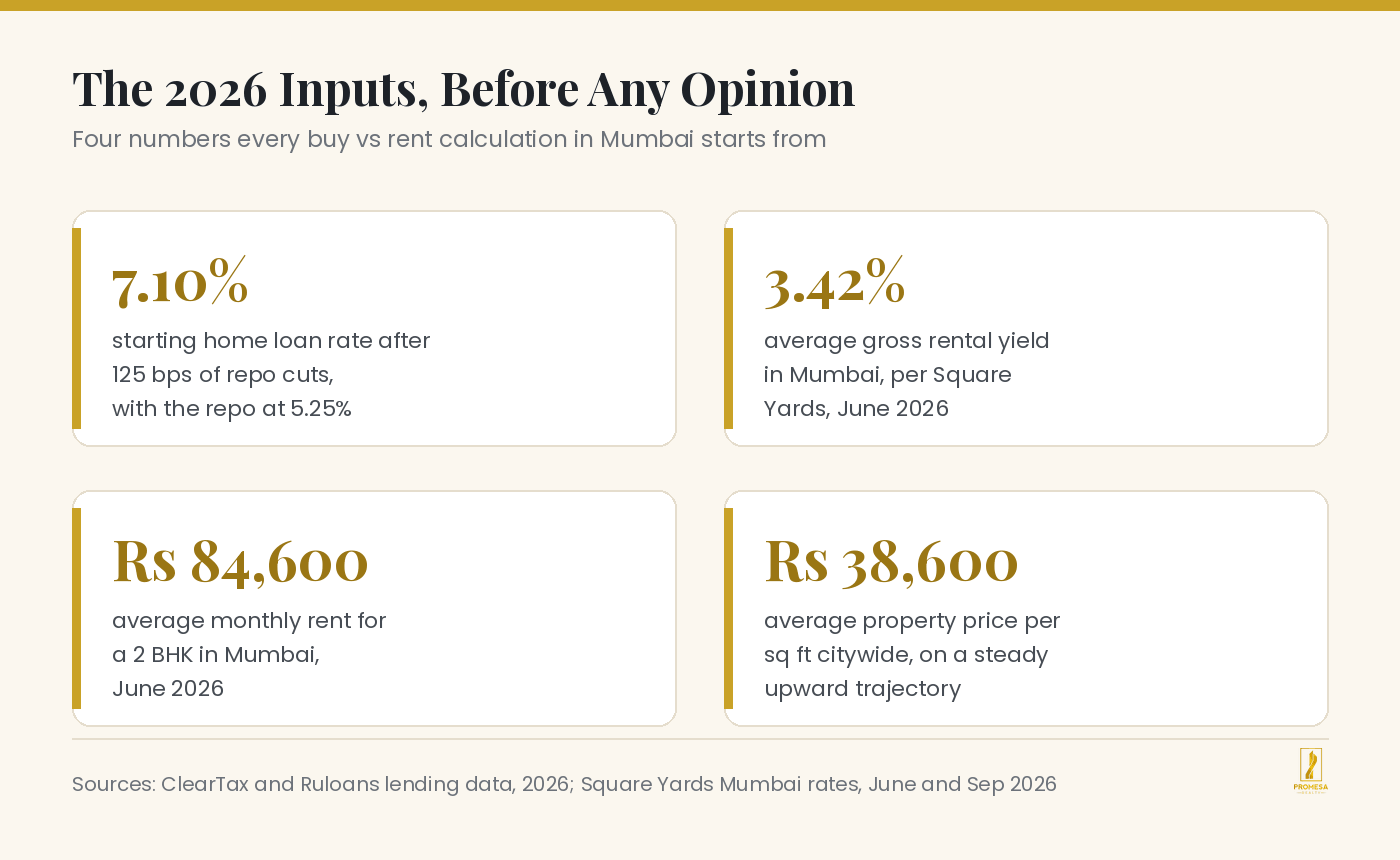
The borrowing side has not looked this friendly in years. After 125 basis points of repo cuts through 2025, the policy rate sits at 5.25 percent and home loans start at 7.10 percent, with well qualified borrowers landing between 7.10 and 7.65 percent. Because new floating loans are repo linked, cuts pass through to EMIs quickly, and the same research notes that shopping across lenders can move your rate by 1.5 to 2 percent, worth lakhs over a tenure.
The renting side is defined by Mumbai’s famous yield gap. The average gross rental yield in Mumbai is about 3.42 percent, with a citywide average rate of ₹38,600 per sq ft and a 2 BHK renting for around ₹84,600 a month; Global Property Guide pegs the city near 3.84 percent. Translated: relative to prices, Mumbai rents are cheap. That is precisely what keeps fence sitters on the fence, and it is why the decision turns on appreciation and holding period rather than on rent versus EMI alone.
| Input | 2026 value | Source |
|---|---|---|
| Home loan starting rate | 7.10% p.a. (repo at 5.25%) | ClearTax, Ruloans lender data |
| Mumbai gross rental yield | 3.42% to 3.84% | Square Yards; Global Property Guide |
| Average 2 BHK rent, citywide | ₹84,600 per month | Square Yards, June 2026 |
| Typical lease escalation | 5% per year | Standard Mumbai leave and licence practice |
| One time purchase costs | ~6.5% (stamp duty, registration) | Maharashtra stamp duty schedule |
The Worked Example: One Household, Two Paths
Meet a household eyeing a ₹2 crore ready 2 BHK. The same flat rents at roughly 3.5 percent yield, about ₹58,000 a month. They have ₹53 lakh available, enough for a 20 percent down payment of ₹40 lakh plus about ₹13 lakh in stamp duty and registration. If they buy, they borrow ₹1.6 crore at 7.5 percent over 20 years.
| Monthly picture | The owner | The renter |
|---|---|---|
| Core outgo | EMI ₹1,28,895, fixed for the tenure | Rent ₹58,000, rising about 5% yearly |
| Maintenance | ₹8,000 society charges | Usually inside the rent |
| Where it goes, year one | ₹11.9 lakh interest, ₹3.6 lakh builds equity | ₹6.96 lakh to the landlord, all expense |
| Monthly gap | The owner pays about ₹79,000 more per month. The whole debate is about what that gap earns on each path. | |
Look at that year one split honestly: early in a loan, most of the EMI is interest. The case for buying is not that EMIs are secretly savings from day one. It is that the EMI is frozen while rent compounds, that a slice of every payment builds equity that grows every year, and that the owner controls a ₹2 crore asset with ₹53 lakh, so every 1 percent of appreciation is nearly 4 percent on their money. Leverage is the quiet engine of property returns, and it works both ways, which is why holding period matters so much.
The 5 Year Scorecard
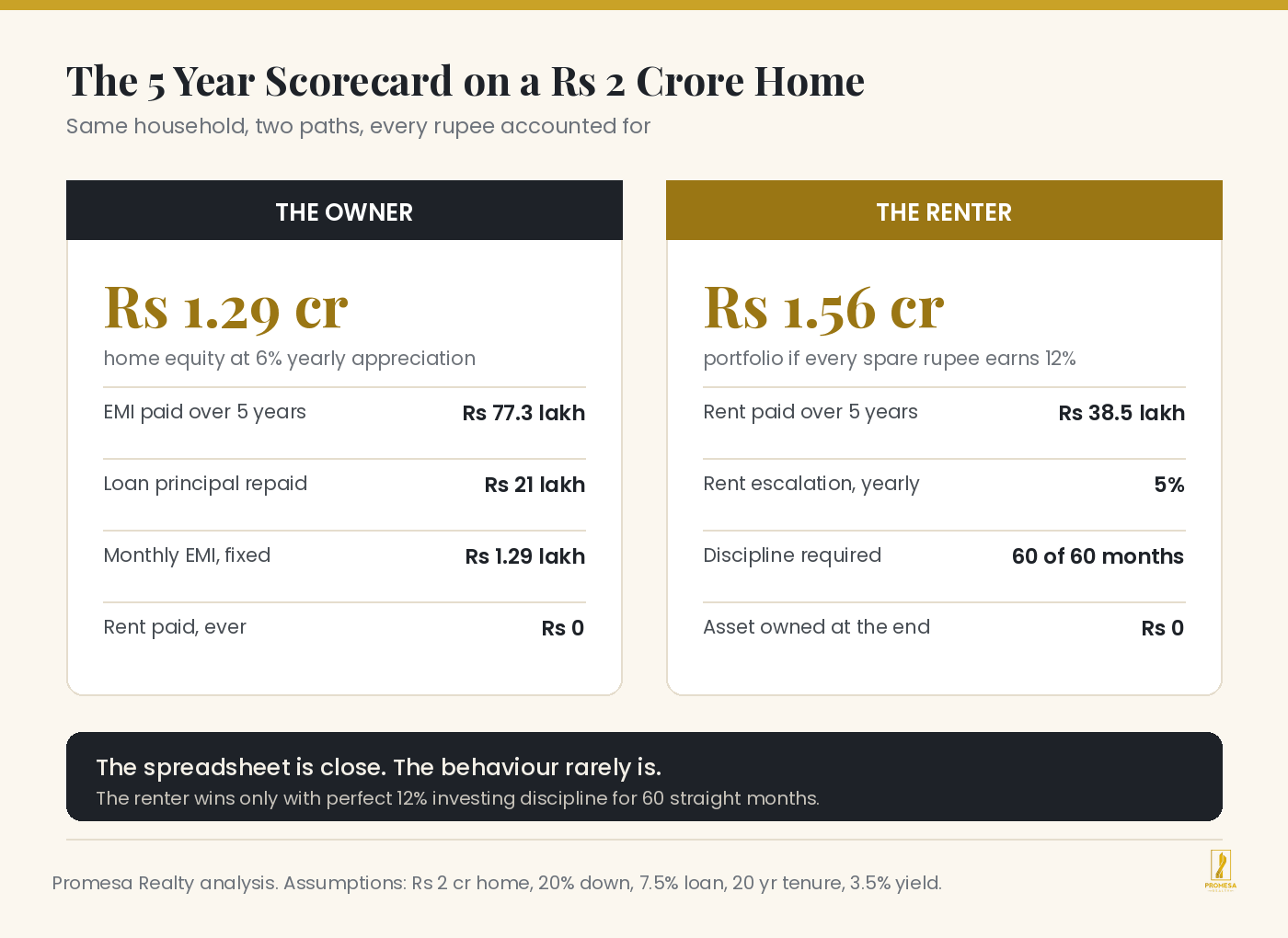
Run both paths for five years. The owner pays ₹77.3 lakh in EMIs, of which ₹21 lakh retires principal, and if the flat appreciates 6 percent a year it is worth ₹2.68 crore against a ₹1.39 crore loan balance: equity of about ₹1.29 crore. The renter pays ₹38.5 lakh in rent and, if they invest the ₹53 lakh lump sum plus the entire monthly difference at 12 percent without missing a single month, holds a portfolio of about ₹1.56 crore. Sensitivity is everything, so here is the same scorecard across appreciation scenarios.
| Scenario after 5 years | Owner’s home equity | Renter’s portfolio at 12% | Who leads |
|---|---|---|---|
| Prices grow 4% a year | ₹1.04 crore | ₹1.56 crore | Renter, clearly |
| Prices grow 6% a year | ₹1.29 crore | ₹1.56 crore | Renter, narrowly |
| Prices grow 8% a year | ₹1.55 crore | ₹1.56 crore | Dead heat |
| Beyond year 5, any scenario | The owner’s position strengthens every year: rent keeps compounding at 5% while the EMI stays frozen, principal repayment accelerates, and leverage keeps multiplying appreciation. | ||
Two honest conclusions fall out. First, over a short horizon with perfect investing discipline, renting is financially respectable in Mumbai; anyone who tells you it is simply throwing money away has not done the math. Second, the renter’s edge rests entirely on that word perfect: 12 percent returns on every spare rupee, 60 months out of 60, through market crashes and salary gaps and life. Home ownership wins in practice as often as it does because an EMI is enforced saving, while a resolution to invest the difference is just a resolution. And the longer the horizon stretches past five years, the more decisively the owner pulls ahead.
“Mumbai remains an appreciation market with selective yield pockets”, which is exactly why holding period, not rent versus EMI, decides this debate.
RealtyPromoo, city rental yield comparison, 2026
What the Spreadsheet Cannot Price
The model above ignores things that decide real lives. In the owner’s favour: no landlord can ask you to leave, no eleventh month renegotiation, renovation freedom, school admission stability, and the fact that a home loan is the cheapest leverage a salaried Indian will ever access, with possible tax deductions depending on your regime. In the renter’s favour: mobility for career moves, no concentration of net worth in one asset on one street, and no exposure if a micro market stagnates. Price the intangibles for your own life; they are worth real percentage points in either direction.
| Keep renting for now if | Buy in 2026 if |
|---|---|
| Your city or career may change within 5 years | You will hold the home for 7 years or more |
| The EMI would exceed about 40% of take home pay | The EMI fits comfortably with an emergency buffer intact |
| You genuinely invest the difference, every month, already | Your savings tend to evaporate without a commitment device |
| You have not yet studied the micro market | You are buying where infrastructure and jobs are compounding |
Fence sitters welcome
Run your numbers with our sales team, no scripts
Bring your rent, your savings and your horizon. We will run this exact math on real homes and tell you honestly which side of the table you belong on today.
If You Buy, Buy Where the Math Compounds
Notice what moved the scorecard most: the appreciation rate. That is a location variable, not a luck variable. Homes near compounding infrastructure and employment have historically out appreciated the city average, the dynamic we mapped corridor by corridor in how Mumbai’s infrastructure boom is reshaping real estate value and in our Mumbai real estate market 2026 outlook. It is why a 2 BHK flat in Dadar sits on two metro corridors, why flats in Lower Parel ride the Coastal Road effect, and why property in Ghatkopar near our delivered Promesa MidTown has compounded for a decade.
The other variable the buyer controls is execution risk, and that is where a developer’s record matters more than any brochure. Promesa Realty has been delivering in Mumbai since 1987, from Adi Darsshan in Lower Parel to ongoing residences like Promesa Fremont in Lalbaug, with every rupee protected by the framework we explained in our home buyer’s guide to RERA. When the spreadsheet says buy, buy verifiable.
Frequently Asked Questions
Is Mumbai’s 3.4 percent rental yield a bad sign for buyers?
Low yield means rents are cheap relative to prices, which favours tenants on monthly cash flow. For owners, Mumbai has historically been an appreciation market: total returns come mostly from price growth on a leveraged asset rather than from rent. That is why holding period, location and entry price matter more here than in high yield cities.
Is renting really throwing money away?
No, and this article’s own math shows it. A renter who invests the down payment and the monthly difference with genuine discipline can match or beat a buyer over a five year horizon. The catch is behavioural: the EMI forces saving automatically, while the renter’s plan requires perfect execution for years. Judge yourself honestly on that point before choosing.
What appreciation rate makes buying clearly win?
In our ₹2 crore example, around 8 percent yearly appreciation brings the owner level with a perfectly disciplined renter within five years, and any longer horizon tilts the result further toward owning because rent escalates while the EMI stays fixed. Corridor selection is how buyers move their expected rate: neighbourhoods with new transit and job density have out appreciated the city average.
How much down payment should I keep?
Lenders typically fund 75 to 90 percent of value; our example uses 20 percent down plus about 6.5 percent for stamp duty and registration. A useful discipline is to size the purchase so the EMI stays near or below 40 percent of take home pay with an emergency fund untouched, rather than stretching for the largest sanctioned loan.
Should I wait for interest rates to fall further?
The repo rate has already absorbed 125 basis points of cuts and has held at 5.25 percent through 2026, so the easy rate gains are behind us. Since new loans are repo linked, a future cut lowers your floating EMI anyway, while waiting exposes you to price appreciation on the entire property value. Timing the market on rates alone usually costs more than it saves.
The Bottom Line
In 2026, the Mumbai buy versus rent question has a genuinely honest answer: renting wins on flexibility and can win on a spreadsheet run with perfect discipline over short horizons, while buying wins on behaviour, leverage and every year you hold past the fifth. If your horizon is long and your location is chosen where infrastructure compounds, the fence is the most expensive place to sit.
Ready to run the math on a real home?
Our sales team will map this exact framework onto specific residences, with your rent, your savings and your timeline. Thirty minutes, real numbers, no pressure.
Data sources: ClearTax and Ruloans home loan rate data, 2026; Square Yards Mumbai property and rental rates, June and September 2026; Global Property Guide rental yields, Q2 2026; RealtyPromoo city yield comparison, 2026. Worked example assumptions: ₹2 crore home, 20 percent down payment, 7.5 percent floating rate, 20 year tenure, 3.5 percent gross yield, 5 percent rent escalation, 6.5 percent one time purchase costs, 12 percent assumed investment return for the renter. All projections are illustrative, not guarantees; property values and returns vary by project and market conditions. This article is general information, not investment, tax or legal advice.