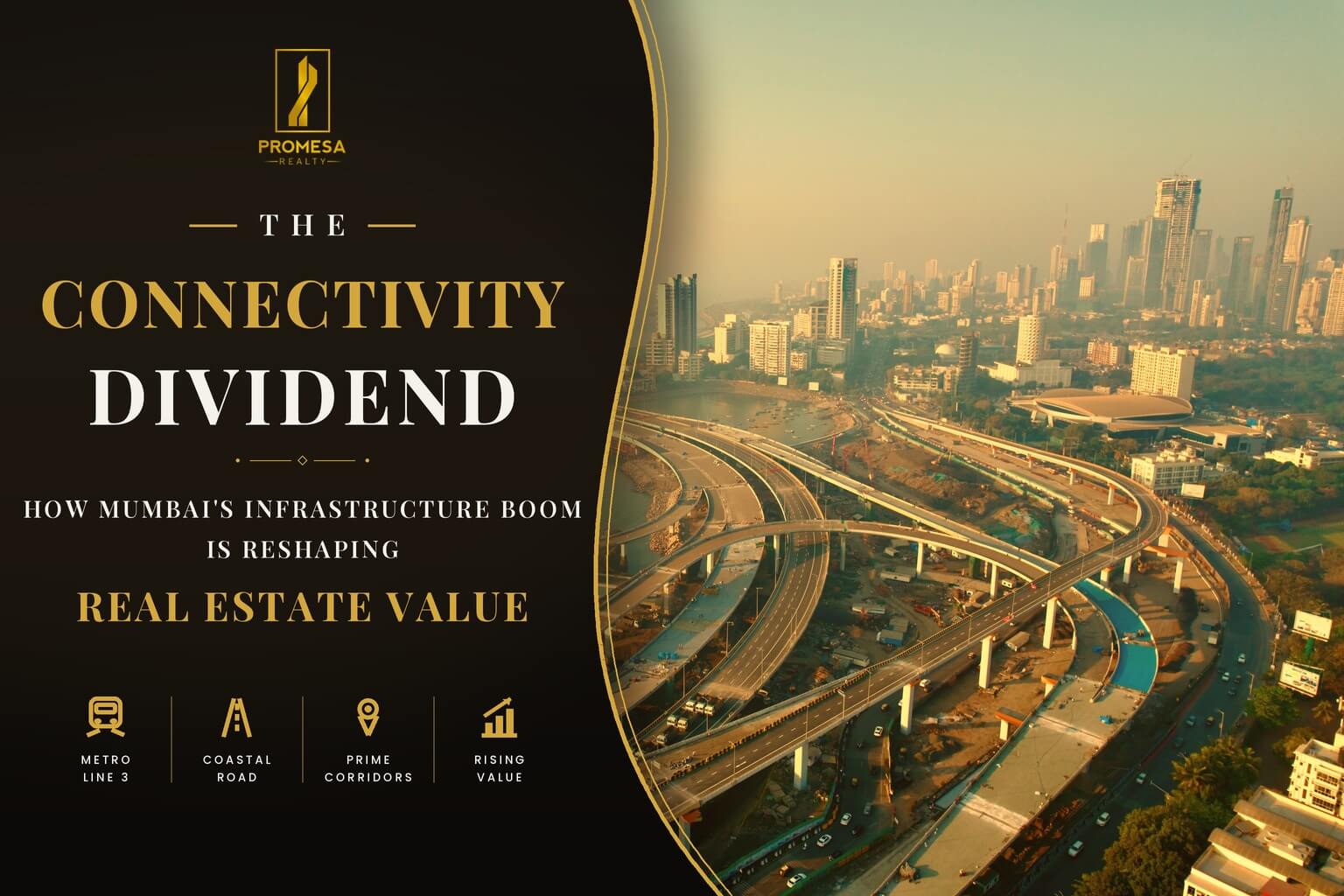
For most of its modern history, Mumbai’s property map was drawn by two railway lines. Where the Western and Central lines went, offices followed, and homes followed the offices. That map is now being redrawn faster than at any point in living memory. In just over two years, the city has opened its first sea bridge to Navi Mumbai, completed its first fully underground metro corridor, switched its Coastal Road to round-the-clock operations, and pushed a series of connectors that stitch these projects into a single network.
For homebuyers, the question is no longer whether infrastructure moves property values. Decades of evidence across Indian cities settle that. The real questions are where the gains will land, how large they might be, and how to position for them before the whole market catches up. As real estate developers in Mumbai who have been building in these very neighbourhoods since 1987, we watch these corridors the way a sailor watches the tide. Here is our reading of the new Mumbai, backed by the latest data, and an honest look at where Promesa Realty’s own addresses sit on this changing map.
A Once in a Generation Build-Out
Cities usually get one transformative project per decade. Mumbai is landing several at once, and their effects compound because they connect to each other. A quick scoreboard as of August 2026:
| Project | Status | What It Changes |
|---|---|---|
| Metro Line 3 (Aqua Line) | Fully operational since October 2025 | A 33.5 km underground spine from Cuffe Parade to Aarey via BKC and the airport belt |
| Mumbai Coastal Road (South) | Open, 24×7 since August 2025 | Marine Drive to Worli in about 10 minutes, toll free, with a new sea promenade |
| Sewri Worli Connector | Under construction, targeted for late 2026 | Links Atal Setu to the Sea Link and Coastal Road straight through Parel and Prabhadevi |
| Atal Setu (MTHL) | Open since January 2024 | Sewri to Navi Mumbai in about 20 minutes, with the new airport beyond it |
| BKC bullet train terminus | Under construction for the Mumbai to Ahmedabad corridor | A six platform underground terminus with direct walkways to Metro Lines 3 and 2B |
| Metro Lines 2B and 9 | First phases opened April 2026 | More east-west and northern links feeding into the wider network |
| Coastal Road North Extension | Under construction, Versova to Dahisar and Bhayandar | Extends the sea corridor to the western suburbs later this decade |
Individually, each of these would have been headline news. Together, they change the arithmetic of where people can live and still reach work, school, the airport, or the sea in reasonable time. That arithmetic is exactly what property markets price.
Metro Line 3: The Underground Spine
The Aqua Line is the single biggest change to how South and Central Mumbai move. Running 33.5 km from Cuffe Parade to Aarey with 27 stations, it is the city’s first fully underground corridor, and it threads directly beneath the neighbourhoods that were hardest to serve by road: Girgaon, Grant Road, Mumbai Central, Mahalaxmi, Worli, Siddhivinayak and Dadar, before swinging east to BKC and the airport belt.
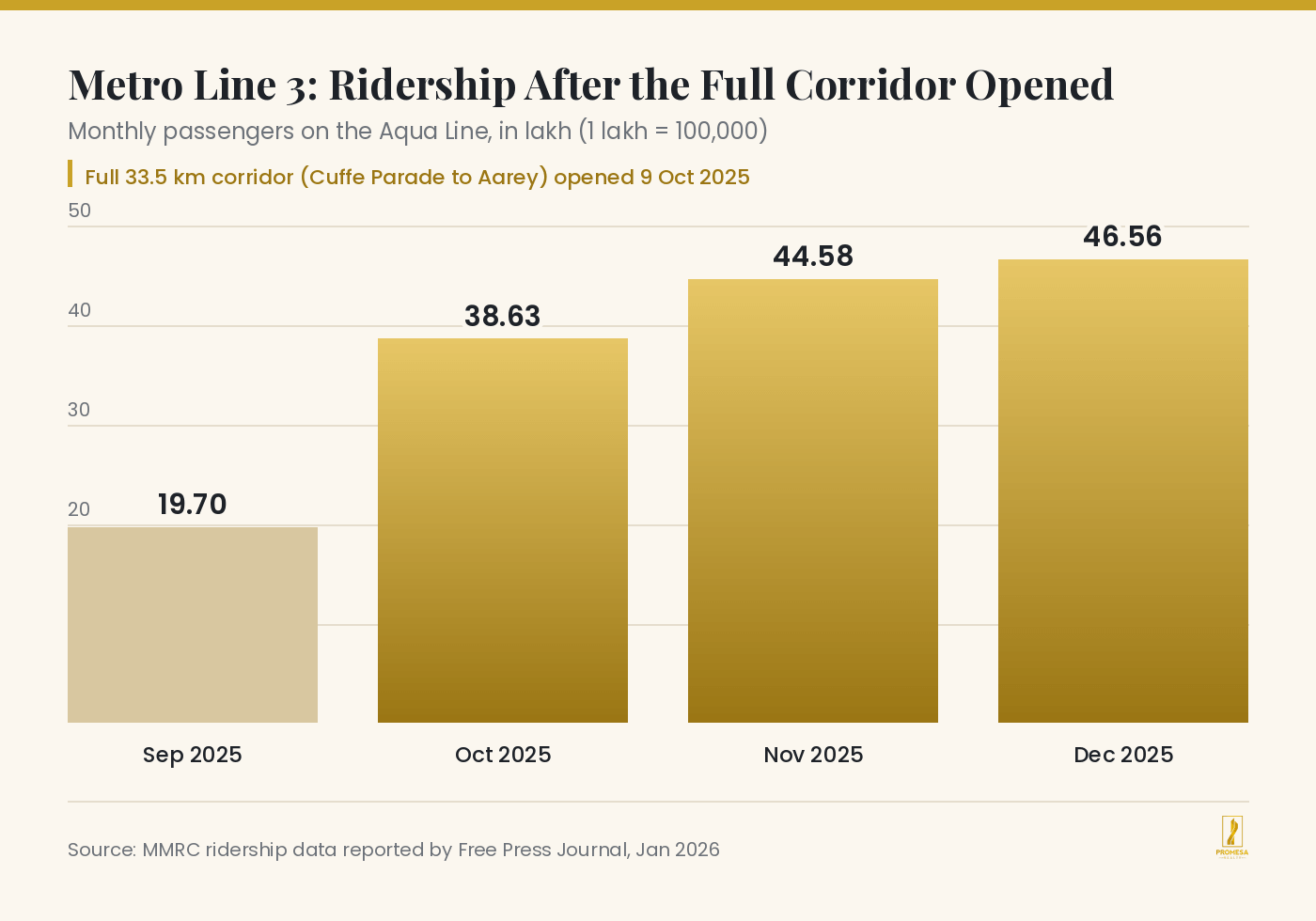
Mumbaikars voted with their feet the moment the full line opened. MMRC data reported by the Free Press Journal shows monthly ridership more than doubling within a quarter of the final stretch opening, and cumulative ridership crossed the 4 crore mark by April 2026. Frequencies were raised in January 2026, with peak headways cut to roughly three minutes.
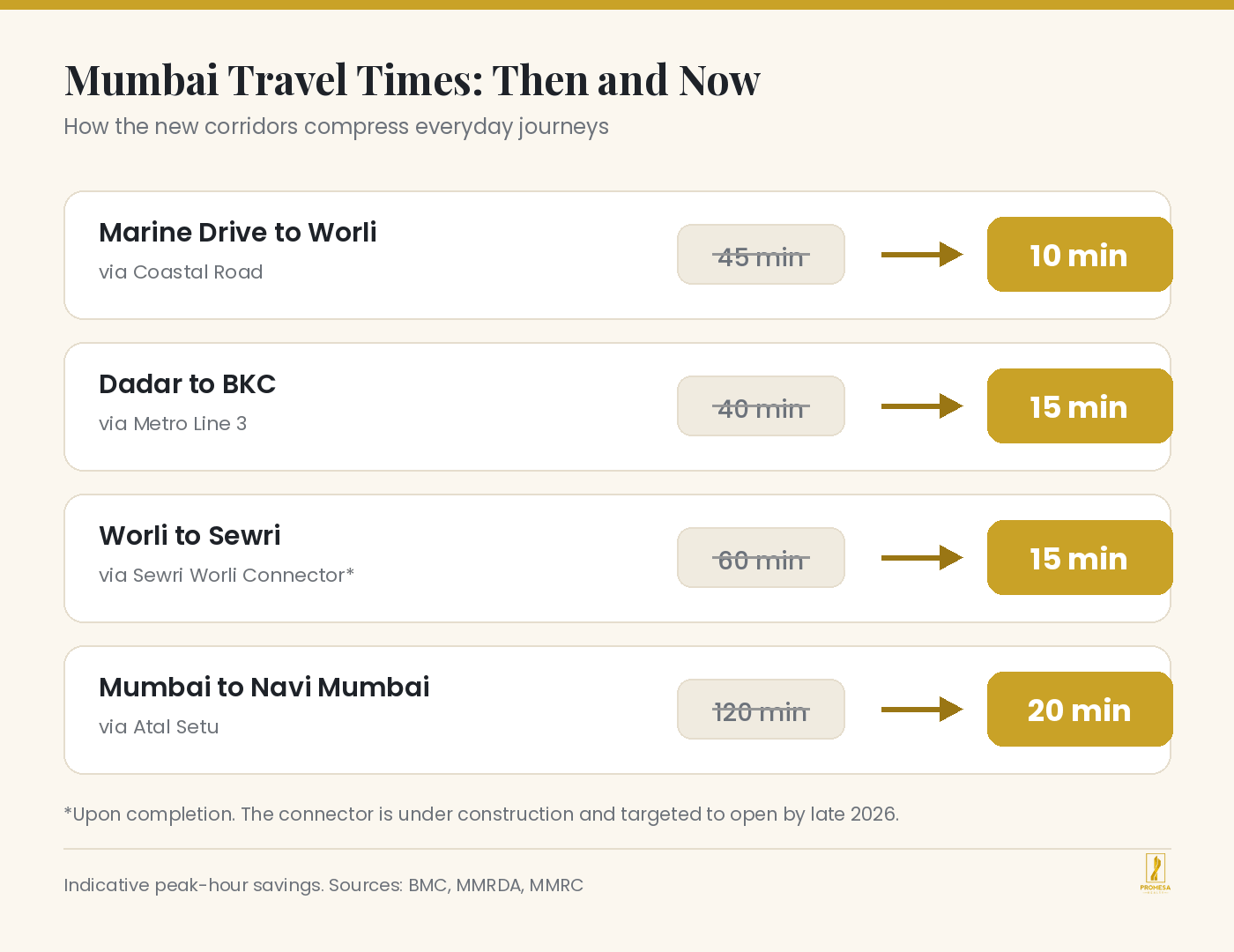
For homebuyers, the practical translation is simple. A resident of Dadar can now reach BKC in about 15 minutes without touching a road. A family in Khetwadi is a short walk from Girgaon station and one line away from both CSMT and the international airport. Mumbai Central has its own underground station beside the railway terminus. Neighbourhoods that always had character but tested your patience in traffic suddenly have big-city convenience to match.
The Coastal Road: Minutes Instead of Hours
If the metro rewired the underground, the Coastal Road rewired the shoreline. The 10.58 km southern stretch between Marine Drive and Worli cut a journey that regularly took 45 minutes down to about 10, and it is toll free. Since access went 24×7 in August 2025, usage has climbed sharply: BMC figures show more than 3.16 crore vehicles carried since launch, with daily volumes now exceeding 30,000 southbound and 27,000 northbound.
The lifestyle dividend is just as real as the time saved. The 5.25 km sea promenade between Priyadarshini Park and Worli, opened in August 2025, has given the city its third great seaside walk after Marine Drive and Bandstand. For residents of Lower Parel, Prabhadevi, Dadar West and the Girgaon belt, an evening by the sea is no longer a weekend project.
The Quiet Game Changer: The Sewri Worli Connector
The least glamorous project on this list may end up mattering most for Central Mumbai. The 4.5 km Sewri Worli Elevated Connector will plug Atal Setu on the eastern waterfront directly into the Bandra Worli Sea Link and the Coastal Road on the west, passing through Parel and Prabhadevi on a new double-decker bridge that replaces the century-old Elphinstone structure. MMRDA expects the crossing between Worli and Sewri to shrink from about an hour to 15 to 20 minutes once it opens, targeted for late 2026.
Think about what that means for the belt in between. Lalbaug, Parel, Byculla, Mazgaon and Sewri sit at the midpoint of a signal-free spine that will run from the Coastal Road on one sea to Atal Setu on the other, with Navi Mumbai and its new international airport beyond. Neighbourhoods long described as central will finally be connected like it.
BKC Keeps Raising the Ceiling
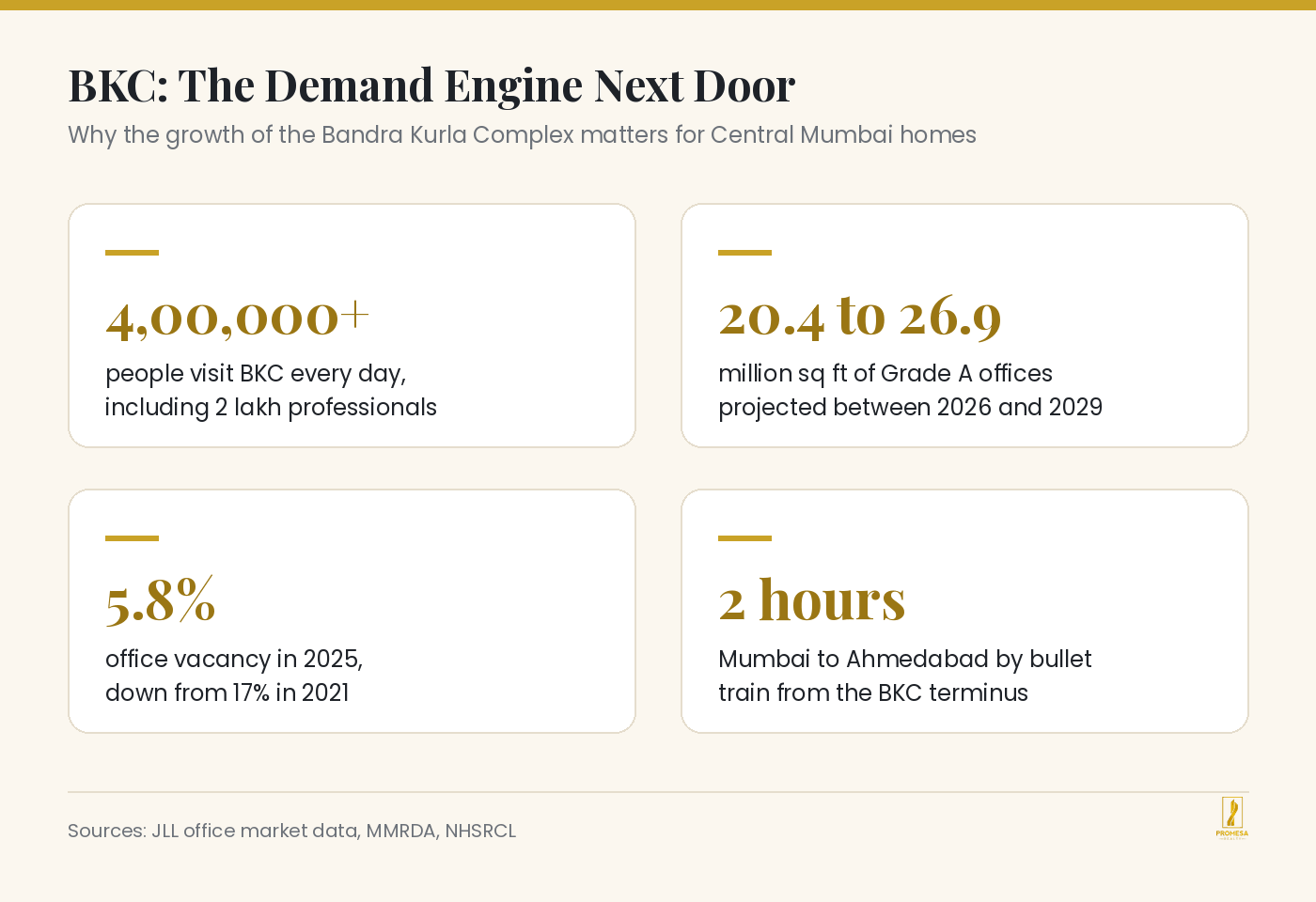
Connectivity is only half the value equation. The other half is where the jobs are, and Mumbai’s premier business district is expanding on both counts. Around four lakh people already move through the Bandra Kurla Complex every day, including roughly two lakh professionals. On the supply side, JLL projects BKC’s Grade A office stock to grow from 20.4 million sq ft in 2026 to 26.9 million sq ft by 2029, even as vacancy has fallen from 17 percent in 2021 to just 5.8 percent in 2025.
Layer the transit onto that. BKC already has its own Aqua Line station, among the busiest on the corridor. The first phase of Metro Line 2B opened in April 2026. And beneath it all, the six platform terminus of the Mumbai to Ahmedabad bullet train is taking shape, planned with a 1.1 km travelator walkway to the Metro 3 station. Every improvement in reaching BKC quietly raises the worth of every home within a 20 minute ride of it, and after Metro 3, that circle now includes Dadar, Parel and Ghatkopar.
What Connectivity Actually Does to Property Values
The mechanism is old and reliable: time saved gets capitalised into price. When a corridor permanently shortens the journey between homes and jobs, buyers pay for those recovered hours, and the effect shows up first in the neighbourhoods closest to the new access points.
Mumbai’s prime residential values rose 8.7 percent in 2025, lifting the city to tenth place worldwide on the Prime International Residential Index.
Knight Frank, The Wealth Report 2026
The corridor-level evidence is just as telling. Market analyses through 2026 indicate that localities served by Metro Line 3 have appreciated roughly 8 to 18 percent faster than the broader Mumbai market, with the strongest effect within about 500 metres of stations in high-demand pockets such as BKC, Worli and Dadar. Micro-markets around the Coastal Road’s access points recorded an estimated 12 to 14 percent uplift in the 18 months after opening. Worli, which enjoys both the Coastal Road and a Metro 3 station, now averages about ₹74,050 per sq ft according to Square Yards data from March 2026, the highest among the corridor-linked locations. Looking ahead, analysts polled by Reuters expect Mumbai home prices to rise 5 to 7 percent a year over the next three years, with connectivity-rich corridors positioned at the upper end of that band. We explored several of these micro-markets in our earlier piece on the Mumbai neighbourhoods seeing the fastest property appreciation.
One honest caveat. Infrastructure raises the tide, but it does not float every boat equally. Within the same pincode, the homes that capture the dividend are the ones with sound construction, thoughtful design, clear titles and a developer who will still be answerable a decade later. Corridors create the opportunity; credibility converts it.
Where Promesa Realty’s Addresses Sit on the New Map
Here is the part we find quietly satisfying. Long before these corridors were sanctioned, our portfolio was concentrated in South and Central Mumbai, in the very neighbourhoods this build-out now serves. That was not luck. It was a belief, held since 1987, that the heart of the city would always find new ways to renew itself. The map below shows how our ongoing, completed and upcoming projects line up against the new network:
| Neighbourhood | Promesa Addresses | Connectivity Gains |
|---|---|---|
| Lower Parel and Parel | Promesa Adi Darsshan, Darshan Heights, Darshan Rico, Excella Residency, upcoming Promesa Lower Parel 2 | Coastal Road interchange at Worli, Metro 3 at Science Museum and Siddhivinayak, and the Sewri Worli Connector passing right through |
| Lalbaug | Promesa Fremont (ongoing) | Minutes from the Atal Setu approach at Sewri, on the axis of the new east-west connector |
| Dadar West | Promesa WestEnd | Two Metro 3 stations, Dadar and Siddhivinayak, within walking reach; BKC in about 15 minutes |
| Khetwadi and Girgaon | Promesa Castor (ongoing), upcoming Promesa Khetwadi 2 | Girgaon station on Metro 3 nearby, with the Coastal Road entry at Marine Drive a short hop away |
| Mumbai Central and Tardeo | Darshan Pride, Darshan Vonalzo, Shree Jayant Darshan, upcoming Promesa Mumbai Central | An underground Metro 3 station at Mumbai Central itself, plus the Haji Ali interchange of the Coastal Road |
| Byculla and Mazgaon | Navkar Darshan, Shankeshwar Darshan, upcoming Promesa Mazgaon | Eastern Freeway at the doorstep and Atal Setu a short drive via Sewri |
| Ghatkopar East | Promesa MidTown | Metro Line 1 today, Metro Line 4 under construction, the Eastern Express Highway, and BKC about 20 minutes away |
Read as a whole, the pattern is striking: every corridor in this story passes through or beside a Promesa neighbourhood. A buyer weighing a 2 BHK flat in Dadar today is really buying a 15 minute commute to BKC. A family considering flats in Lower Parel is buying the Coastal Road, the promenade and the coming east-west spine in one decision. And anyone tracking property in Ghatkopar is effectively tracking two metro lines and a freeway. We wrote in detail about the Lalbaug story in our piece on Promesa Fremont and the transformation of Lalbaug.
Promesa Realty
Own an address on Mumbai’s new map
From Lalbaug to Lower Parel, our ongoing and upcoming homes sit where the city’s new corridors meet its oldest neighbourhoods.
Building Ahead of the Curve
Being forward-thinking in real estate is not about predictions. It is about positioning. Promesa Realty was formed through the synergy of Darsshan Properties and Hirani Ventures, two names that have shaped South and Central Mumbai’s skyline since 1987. Across nearly four decades and more than twenty delivered projects, the philosophy captured in our story has stayed constant: choose neighbourhoods with enduring fundamentals, then build homes worthy of them.
That is also why we design every new project as a future-ready home rather than a snapshot of today’s checklist. Layouts that adapt as families grow. Common areas planned for the way people actually live and work now. Construction quality meant to be judged in 2046, not just at possession. When the city invests decades into its infrastructure, we believe your home should be built on the same time horizon. For a wider view of where the market stands, our Mumbai real estate market report for 2026 is a useful companion to this piece.
Frequently Asked Questions
Which infrastructure projects are affecting Mumbai property values the most in 2026?
Four stand out: Metro Line 3, which links South Mumbai, Worli, Dadar, BKC and the airport belt underground; the Coastal Road, which compressed the Marine Drive to Worli journey to about 10 minutes; Atal Setu, which opened Navi Mumbai and its new airport to a 20 minute crossing; and the Sewri Worli Connector, which will join all of these into one east-west spine by late 2026. BKC’s continued commercial expansion multiplies the effect of each.
How much can connectivity add to property prices?
Market studies through 2026 suggest Metro 3 corridor localities have appreciated roughly 8 to 18 percent faster than the wider Mumbai market, and areas near Coastal Road access points saw an estimated 12 to 14 percent uplift within 18 months of opening. Citywide, Knight Frank recorded 8.7 percent prime price growth in 2025. Actual outcomes vary with micro-location, project quality and the developer’s track record.
Is it better to buy before or after an infrastructure project opens?
Prices typically move in stages: at announcement, during visible construction, and again once the project opens and daily life actually changes. Buying ahead of completion usually captures more of the appreciation, provided the location’s fundamentals do not depend on the project alone. The corridors around Parel, Lalbaug and Sewri, where the connector opens by late 2026, are a live example of this window.
Which Promesa Realty locations benefit most from the new connectivity?
Practically all of them, which reflects where we chose to build. Promesa Fremont in Lalbaug and our upcoming Mazgaon and Lower Parel projects sit on the new east-west spine. Promesa WestEnd is a short walk from two Metro 3 stations in Dadar, Promesa Castor is near Girgaon station, Promesa Mumbai Central rises beside its own underground station, and Promesa MidTown in Ghatkopar East gains from two metro lines and the Eastern Express Highway.
Do smaller homes gain too, or only luxury apartments?
Both, and sometimes compact homes gain more in percentage terms because commute savings matter most to daily office-goers. Well-located 1 BHK homes in Dadar and similar central pockets pair strong end-user demand with healthy rental interest from professionals working in BKC and South Mumbai.
The View from Here
Mumbai has always rewarded those who could read its map a few years ahead. The mills became mixed-use districts, the docks are becoming waterfronts, and now a lattice of tunnels, sea roads and connectors is knitting the island city together in ways commuters could only dream about a decade ago. The neighbourhoods at the centre of that lattice, from Girgaon to Ghatkopar, are not just getting faster journeys. They are getting a structural upgrade to their long-term value.
Our promise, as one of the top real estate builders in Mumbai, is to keep building homes that deserve these addresses: crafted with care, delivered with integrity, and designed for the decades this infrastructure will serve. The city is investing in its future. We would be honoured to help you invest in yours.
Ready for a future-ready home?
Speak with our team about ongoing and upcoming residences across South and Central Mumbai, and find the address that puts the new city within your reach.
Data referenced in this article is drawn from MMRC ridership disclosures, BMC traffic figures, MMRDA project updates, NHSRCL, JLL office market research, Knight Frank’s The Wealth Report 2026 and Square Yards Data Intelligence, current as of August 2026. Figures are indicative and subject to official revision.