

A decade ago, “fully loaded” in a Mumbai flat meant modular kitchens and imported flooring. Today, the sharpest buyers walk into a show flat and ask a different set of questions. Can I see who is at the door from my office? Will the wiring take a smart lock without breaking the frame? What does my electricity use look like on my phone? Homes are being judged on intelligence, not just marble, and the buyers asking these questions are usually the ones who negotiate best.
This guide is Smart Homes 101 for the Mumbai buyer: what the technology actually covers, which features matter at purchase time versus what can wait, and the questions that separate a genuinely smart ready flat from a brochure that just says so. It is the same first principles approach top real estate builders in Mumbai should apply to their own specifications, so consider this both a buyer’s guide and a look at our own checklist.
Why Smart Is Suddenly the Standard
The numbers explain the shift. India’s smart home market stands at USD 6.71 billion in 2026 and is projected to reach USD 24.1 billion by 2031, a 29.12 percent compound annual growth rate. Three forces converged to get here: 5G coverage now spans 779 districts, rooftop solar incentives under PM Surya Ghar made energy intelligence financially interesting, and the cross vendor Matter protocol finally let devices from different brands work together. As Mordor Intelligence puts it, household automation has moved “from a discretionary upgrade into a mainstream expectation”.
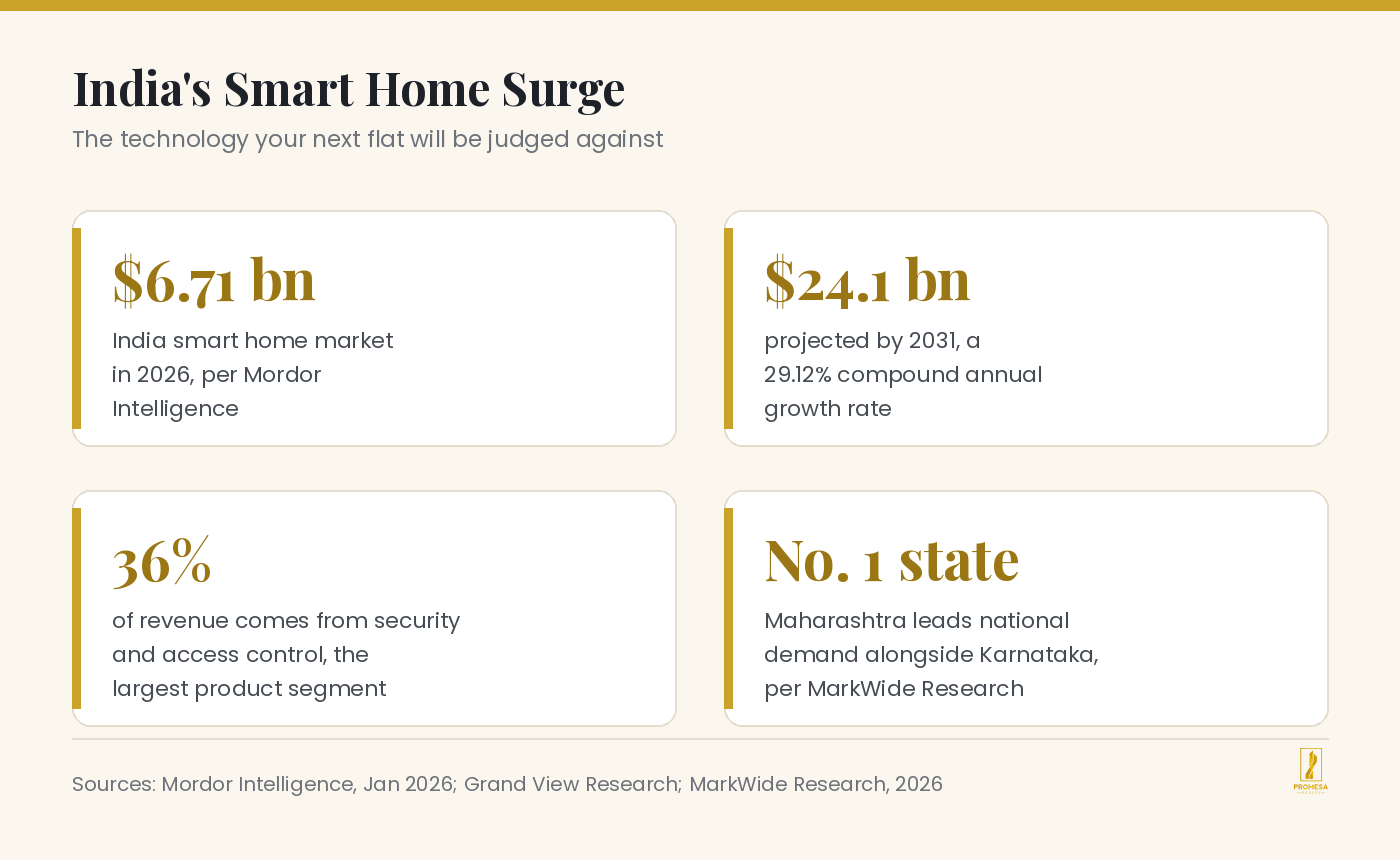
Two details matter specifically for Mumbai buyers. First, security and access control is the largest product segment, contributing about 36 percent of revenue, which tells you what Indian households actually buy first. Second, demand concentrates in Maharashtra and Karnataka, driven by premium residential construction. In other words, the smart home wave is not coming to Mumbai. It is already here, and it is strongest in exactly the premium segment where most of this city’s new supply sits.
The Three Pillars of a Smart Flat
Pillar 1: Home automation
Automation is the layer that makes a home respond to you: lights that follow scenes rather than switches, curtains and ACs on schedules, geysers that are hot when you wake and off when you leave. The technology splits into wired systems, planned into the building during construction, and wireless systems added afterward. Wireless retrofits have become dramatically better and cheaper, but they still depend on what is inside the walls: neutral wiring at switchboards, conduit capacity for future cabling and a distribution board with room to grow. That is why automation is a purchase time question. Devices can be bought next year; wiring decisions are forever. When comparing projects, also ask about Matter compatibility. It is the interoperability standard that keeps you free to mix brands over the decade you will live in the home, instead of being locked into whatever ecosystem was fashionable at possession.
Pillar 2: Security
There is a reason security is India’s biggest smart home category. In a vertical city, the front door is only the last checkpoint; real security is layered through the building. At the flat level, look for a video door phone with app access so a delivery at noon does not require someone home, a main door that accepts a standard smart lock, and provisioning for door and window sensors. At the building level, ask how CCTV coverage, entry control and visitor management work together, and whether alerts reach your phone or stop at the security desk. The best setups make the guard’s job easier and your visibility total. The worst are cameras that record locally onto a hard disk nobody checks.
Pillar 3: Energy efficiency
Energy is where smart features quietly pay for themselves. App readable energy monitoring turns an opaque monthly bill into a live dashboard, and households that can see consumption reliably trim it. Layer on 5 star rated appliances, all LED lighting design, inverter ACs on automation schedules and, where the society adopts it, rooftop solar under the PM Surya Ghar incentives, and the running cost gap between an efficient flat and an ordinary one compounds every single month. For an asset you may hold for decades, that gap is real money. It is also increasingly a resale argument: the next buyer inherits your electricity bills.
Basic, Smart Ready or Fully Automated: Know What You Are Buying
| Feature area | Basic flat | Smart ready flat | Fully automated flat |
|---|---|---|---|
| Entry | Peephole and bell | Video door phone, smart lock ready door | App linked lock, camera and sensor suite |
| Lighting | Standard switches | Neutral wiring and conduits for smart switches | Scene based control in every room |
| Climate | Manual AC remotes | Smart plugs and IR control possible | Scheduled, sensor driven climate zones |
| Energy | Monthly bill only | Metering readable via app | Circuit level monitoring and automation |
| Internet | Single provider, ad hoc wiring | FTTH provisioned, mesh friendly layout | Structured cabling with wired access points |
| Cost logic | Cheapest today, costliest to upgrade | Small premium, full flexibility later | Highest upfront, best daily experience |
The middle column is the one to internalise. A smart ready flat does not need every gadget installed on day one. It needs the invisible groundwork done right, so that everything visible remains your choice, at your pace, on your budget. Most buyers are best served by paying the small premium for smart ready construction and then building up the device layer over their first two years in the home.
The 7 Point Smart Ready Checklist
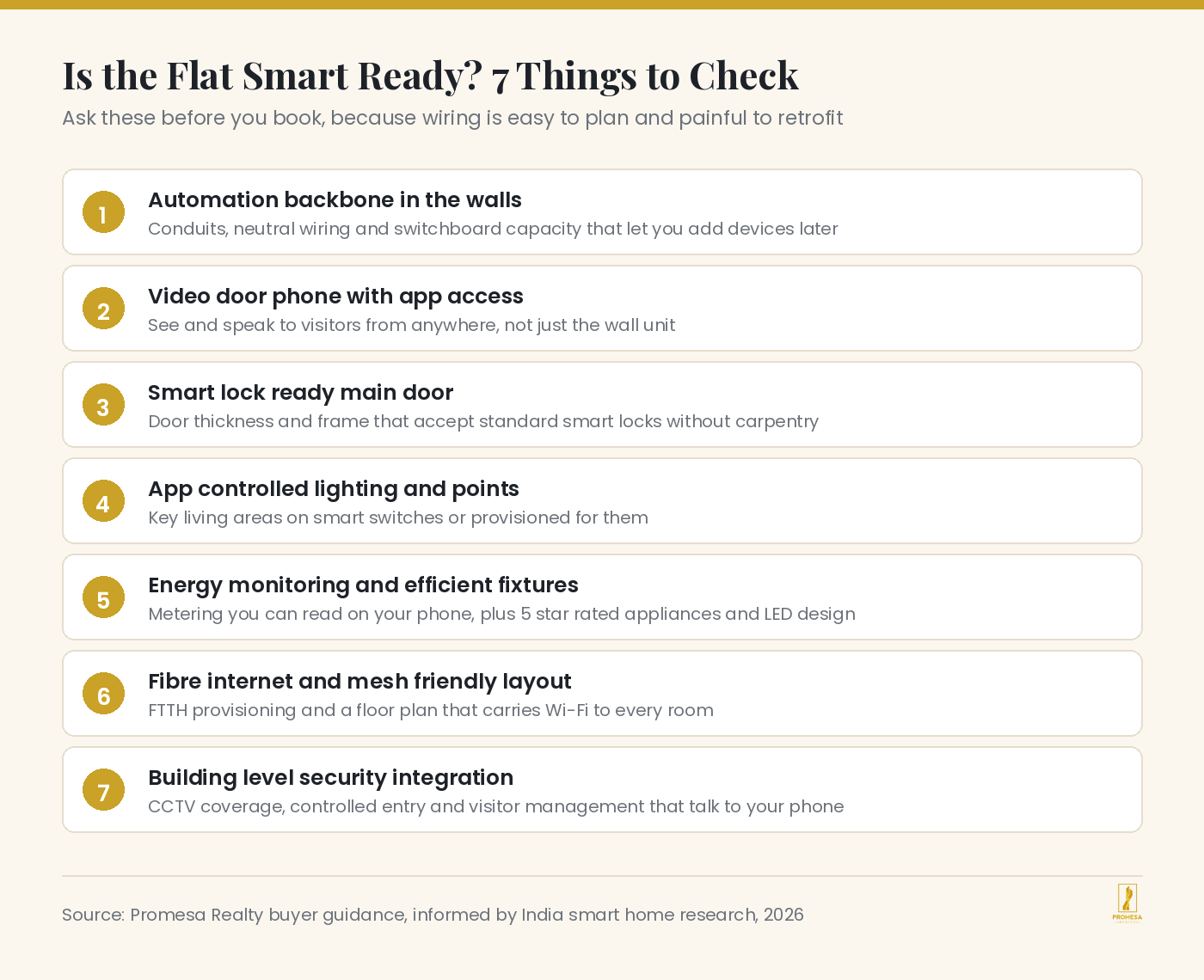
Use the checklist at the show flat, not after possession. Ask to see the switchboard behind its panel, not just the panel. Ask which conduits run empty and where they terminate. Ask whether the video door phone is a standalone unit or connects to an app, and whose app. Ask what happens to the security system if the developer’s chosen vendor disappears in five years. Concrete answers signal a project that was engineered; vague ones signal a brochure line. And as with everything in a purchase this size, verify the fundamentals first: a smart switchboard cannot fix a weak title, so run the checks from our home buyer’s guide to RERA before any of this.
Household automation in India has shifted “from a discretionary upgrade into a mainstream expectation”.
Mordor Intelligence, India Smart Home Market report, January 2026
Homes built for what comes next
Ask us the seven questions. We enjoy answering them.
Walk through our ongoing and upcoming residences and put this checklist to work, switchboards and all.
How Promesa Approaches Future Ready Homes
We describe our residences as future ready homes, and technology readiness is a large part of what that phrase commits us to. Our design philosophy is simple: the buildings we deliver will house families for fifty years, so the infrastructure inside the walls has to accommodate technology none of us have seen yet. That means treating electrical planning, conduit capacity and connectivity provisioning as structural decisions rather than finishing touches, in ongoing projects like Promesa Fremont in Lalbaug and Promesa Castor in Khetwadi, and in the upcoming launches across Central and South Mumbai you can track on our projects page.
It is also why we publish guides like this one. An informed buyer asks harder questions, and harder questions reward developers who build carefully, a standard we have held since 1987 through the delivered landmarks you can read about on our about us page. Whether you are evaluating flats in Lower Parel, comparing 1 BHK homes in Dadar or exploring property in Ghatkopar near our delivered MidTown tower, bring the checklist along. The right home will pass it comfortably.
Buying an Older Flat? What Retrofits Can and Cannot Fix
Smart technology is forgiving to owners of older flats, up to a point. Wireless smart locks, plug in energy monitors, Wi-Fi cameras, smart plugs and retrofit smart switches can modernise most homes over a weekend. What retrofits struggle with is capacity: a distribution board with no spare ways, aluminium era wiring without neutrals at switch points, walls without conduits and layouts that strangle Wi-Fi. Those fixes involve civil work, society permissions and real money. So if you are choosing between an older flat and a smart ready new one at similar prices, weigh the retrofit ceiling honestly. And if you are staying put, start with the three retrofits that return the most per rupee: a video door phone, a smart lock and an energy monitor. Connectivity matters beyond the flat too; a neighbourhood’s infrastructure trajectory moves value just as surely, a dynamic we mapped in our study of how Mumbai’s infrastructure boom is reshaping real estate value and our Mumbai real estate market 2026 outlook.
Frequently Asked Questions
Do smart home features make a flat significantly more expensive?
Smart ready construction adds a small premium, mostly in electrical planning and provisioning, while the visible device layer is bought at your own pace. Full home automation installed at possession costs more, but buyers can achieve most of the daily benefit with a phased approach: smart ready flat first, devices over the first year or two.
Can I make an ordinary flat smart later?
Substantially, yes. Wireless locks, cameras, plugs and retrofit switches work in most homes. The hard limits are structural: switchboard capacity, neutral wiring, conduits and floor plans that block Wi-Fi. Those are expensive to change, which is why wiring quality belongs on your purchase checklist even if you plan to buy devices later.
Which smart features add the most resale value?
Features the next buyer cannot easily add themselves: provisioned wiring, structured connectivity, integrated building security and energy efficient design. Portable gadgets move out with you; infrastructure stays and gets priced in.
What is the Matter protocol and should I care?
Matter is a cross brand interoperability standard that lets smart devices from different companies work together. For a buyer, it means freedom: you are not locked into one vendor’s ecosystem for the life of the home. When a project advertises automation, asking about Matter compatibility is a quick way to test how current the specification really is.
What technology provisioning do Promesa projects include?
Specifications vary by project and are detailed in each project’s official documentation. The fastest way to get exact answers for a home you are considering is to ask our team directly through the contact page or during a site visit; we will walk you through the electrical planning, security systems and connectivity provisioning for that specific residence.
The Bottom Line
The smartest thing about a smart home is rarely visible in the show flat. It is the neutral wire behind the switch, the empty conduit in the wall, the fibre line into the shaft and the security system that treats your phone as part of the building. Judge flats on that invisible layer, use the seven point checklist without embarrassment, and buy the home that will still feel current when the gadgets of 2026 are museum pieces.
Want a home that answers all seven questions?
Bring this guide to a Promesa site visit and test us on it. We will show you the switchboards, not just the show flat.
Data sources: Mordor Intelligence, India Smart Home Market report, January 2026; Grand View Research, India smart home market outlook; MarkWide Research, India Home Automation Market, 2026; IMARC Group, India smart home devices market. Market figures are estimates by the respective research firms and vary by methodology. This article is for general information; project specifications are governed by official project documentation.