

Decoding RERA: A Home Buyer’s Guide to Safe Real Estate Investment in Maharashtra
For most families, a home is the single largest purchase of a lifetime. It is also the one purchase where, for decades, Indian buyers had the least protection. Booking amounts vanished into stalled towers, possession dates slipped by years and the flat that was promised on paper rarely matched the one that was delivered. The Real Estate (Regulation and Development) Act, 2016, better known as RERA, was written to end exactly that imbalance, and nowhere has it been enforced more actively than in Maharashtra.
This guide explains, in plain language, what RERA and MahaRERA actually do for you, the specific rights you hold as a buyer, how to verify any project in five minutes and how real estate developers in Mumbai like Promesa Realty build these protections into the way a project is planned, funded and delivered.
What Home Buying Looked Like Before RERA
Before 2017, the rules of the game were written almost entirely by the seller. A project could be advertised and sold before a single approval was in place. Money collected for one building could quietly fund land purchases for another. Homes were priced on vague super built up areas that inflated the size of what you were paying for. And when possession dates slipped, the buyer had no practical forum to turn to except long civil litigation.
RERA rewired all of it. The Act created a dedicated regulator in every state, made registration compulsory for new and ongoing projects, standardised how homes are measured and priced, ring fenced buyer money and gave home buyers a fast, low cost forum for complaints. Maharashtra notified its authority, MahaRERA, on 1 May 2017, making it one of the first states in India to bring the law fully to life, and it has remained the most active regulator in the country since.
RERA and MahaRERA at a Glance
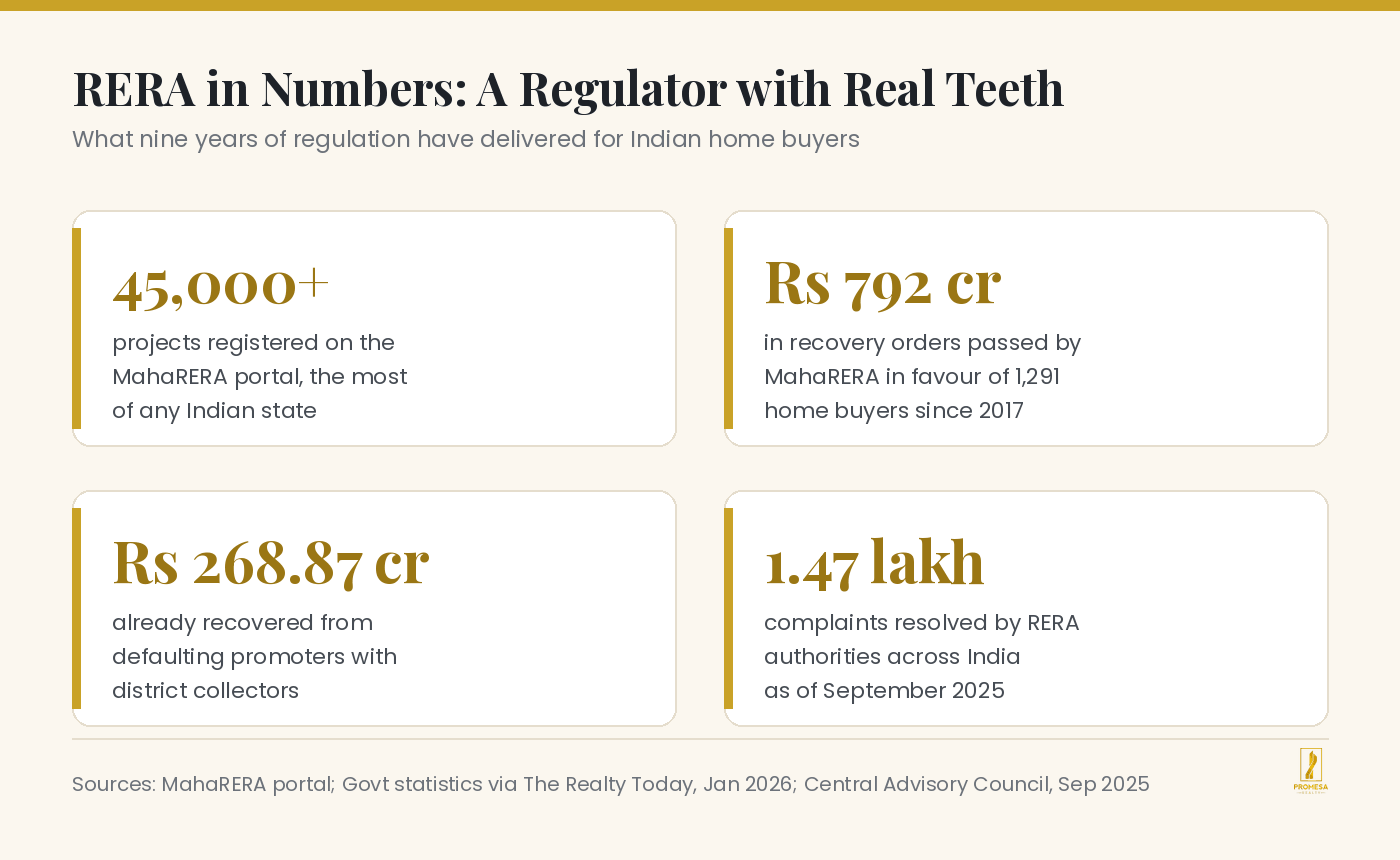
The scale tells its own story. More than 45,000 projects are registered on the MahaRERA portal, the highest of any Indian state. Nationally, RERA authorities had resolved about 1.47 lakh consumer complaints by September 2025. And the enforcement is not symbolic: MahaRERA has passed recovery orders worth ₹792 crore in favour of 1,291 home buyers, of which ₹268.87 crore has already been recovered through district collectors.
| Measure | Figure | What it means for you |
|---|---|---|
| Projects registered with MahaRERA | 45,000+ | Almost every legitimate new project in the state is on one searchable portal |
| Complaints resolved by RERA bodies across India | 1.47 lakh (Sep 2025) | A tested, functioning grievance system, not just a law on paper |
| Recovery orders passed by MahaRERA | ₹792 crore for 1,291 buyers | Orders convert into recovery warrants executed like land revenue dues |
| Amount already recovered for buyers | ₹268.87 crore | Real money returned to real families, not only penalties announced |
| Private equity inflows into Indian real estate, 2017 to 2020 | $26 billion | Institutional money trusts a regulated market, which supports price stability |
Sources: MahaRERA portal; government statistics reported by The Realty Today, January 2026; Central Advisory Council data, September 2025; Knight Frank India and NAREDCO report, August 2025.
The Seven Protections Every Maharashtra Home Buyer Should Know
1. No registration, no sale
A promoter cannot advertise, market or sell a single unit in a new or ongoing project without first registering it with MahaRERA and receiving a registration number. That number must appear on every advertisement and brochure. Registration forces disclosure: title reports, sanctioned plans, approvals, project timelines and quarterly progress updates all go on the public portal before your money goes anywhere.
2. The 70 percent money rule, now with three accounts
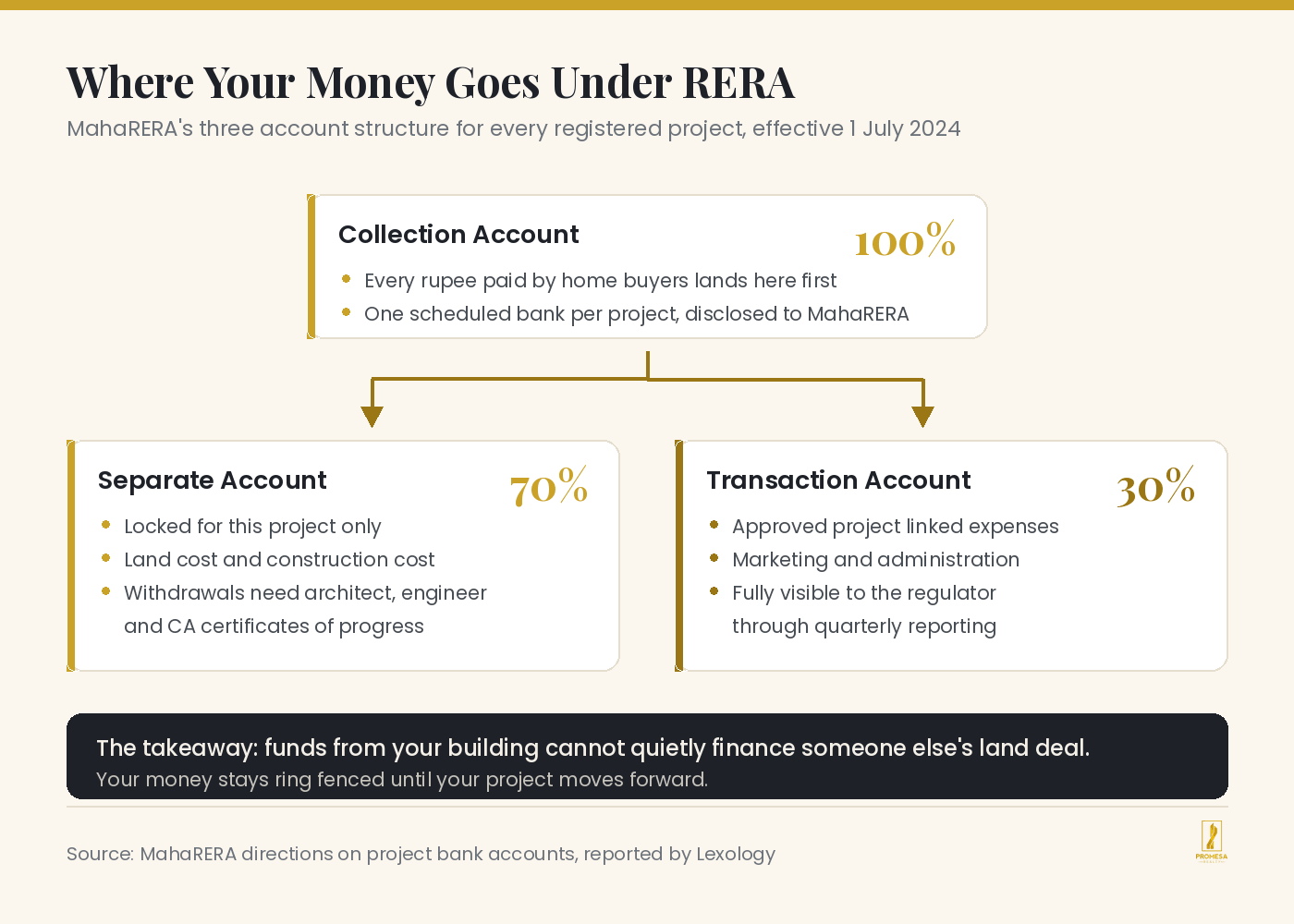
The Act’s most powerful idea is financial discipline. At least 70 percent of everything collected from buyers must sit in a dedicated project account and can be used only for that project’s land and construction costs. From 1 July 2024, MahaRERA tightened this further with a mandatory three account structure: a Collection Account that receives 100 percent of buyer money, a Separate Account holding the 70 percent that is locked for construction and land, and a Transaction Account for the remaining 30 percent of approved project expenses. Withdrawals from the locked account require certification from an architect, an engineer and a chartered accountant confirming actual progress.
3. You pay for carpet area, not air
RERA defines and mandates pricing on carpet area, the net usable floor area within your walls. The old practice of quoting super built up areas, which bundled lobbies, staircases and marketing imagination into your price per square foot, is gone from agreements. What you are shown is what you are buying.
4. The possession date is a commitment, not a suggestion
The completion date declared at registration and written into your agreement for sale is legally enforceable. If the promoter fails to deliver on time, Section 18 of the Act gives you a choice: exit the project with a full refund plus prescribed interest, or stay invested and receive interest for every month of delay. MahaRERA orders on this point are consistent, and financial difficulty on the promoter’s side is treated as a business risk of the promoter, never a burden the buyer must absorb.
5. Five year defect liability
Any structural defect or deficiency in workmanship reported within five years of possession must be rectified by the promoter at no cost to you, ordinarily within 30 days. Quality obligations no longer end at the handover ceremony.
6. Your flat cannot be redrawn without you
Once plans are disclosed, the promoter cannot alter the sanctioned layout of your unit without your consent, and material changes to the project as a whole require consent from two thirds of the buyers. The tower you booked into is the tower that must be built.
7. Token amounts are capped
A promoter cannot accept more than 10 percent of the cost of the apartment before a written agreement for sale is registered. This single rule ended the era of large unsecured booking amounts handed over against a glossy brochure.
Before and After: How RERA Changed the Ground Rules
| Aspect | Before RERA | After RERA |
|---|---|---|
| Project launch | Sales could begin before approvals existed | Registration and disclosure mandatory before any marketing |
| Buyer money | Freely movable across projects and land deals | 70 percent locked per project in a monitored account structure |
| Pricing basis | Super built up area, loosely defined | Carpet area, defined by law and stated in the agreement |
| Delays | Buyer absorbed the cost of every slipped deadline | Refund with interest, or interest for delay, at the buyer’s option |
| Construction quality | Little recourse after possession | Five year defect liability, plus annual quality assurance disclosures |
| Disputes | Years in civil courts | Dedicated authority, conciliation forum and appellate tribunal |
A Regulator That Keeps Raising the Bar
MahaRERA has not stood still. Recent years brought a project grading framework, mandatory annual quality assurance certificates covering structural design, material quality and safety measures, standardised agreement clauses and the MahaCRITI digital system that moves compliance, scrutiny and complaints onto a single platform. Independent industry research confirms the direction of travel. A 2025 study by Knight Frank India and NAREDCO concluded that the Act has aligned price growth with fundamentals and strengthened long term confidence in housing.
The regulation has “curbed speculation, moderated prices, restored consumer trust” in India’s housing market.
Knight Frank India and NAREDCO assessment, reported by Business Standard, August 2025
For buyers, the practical meaning is simple: the information asymmetry that once defined property purchases has collapsed. Everything material about a project, from its title report to its quarterly construction photographs, is a search away.
Your Five Minute Verification Routine
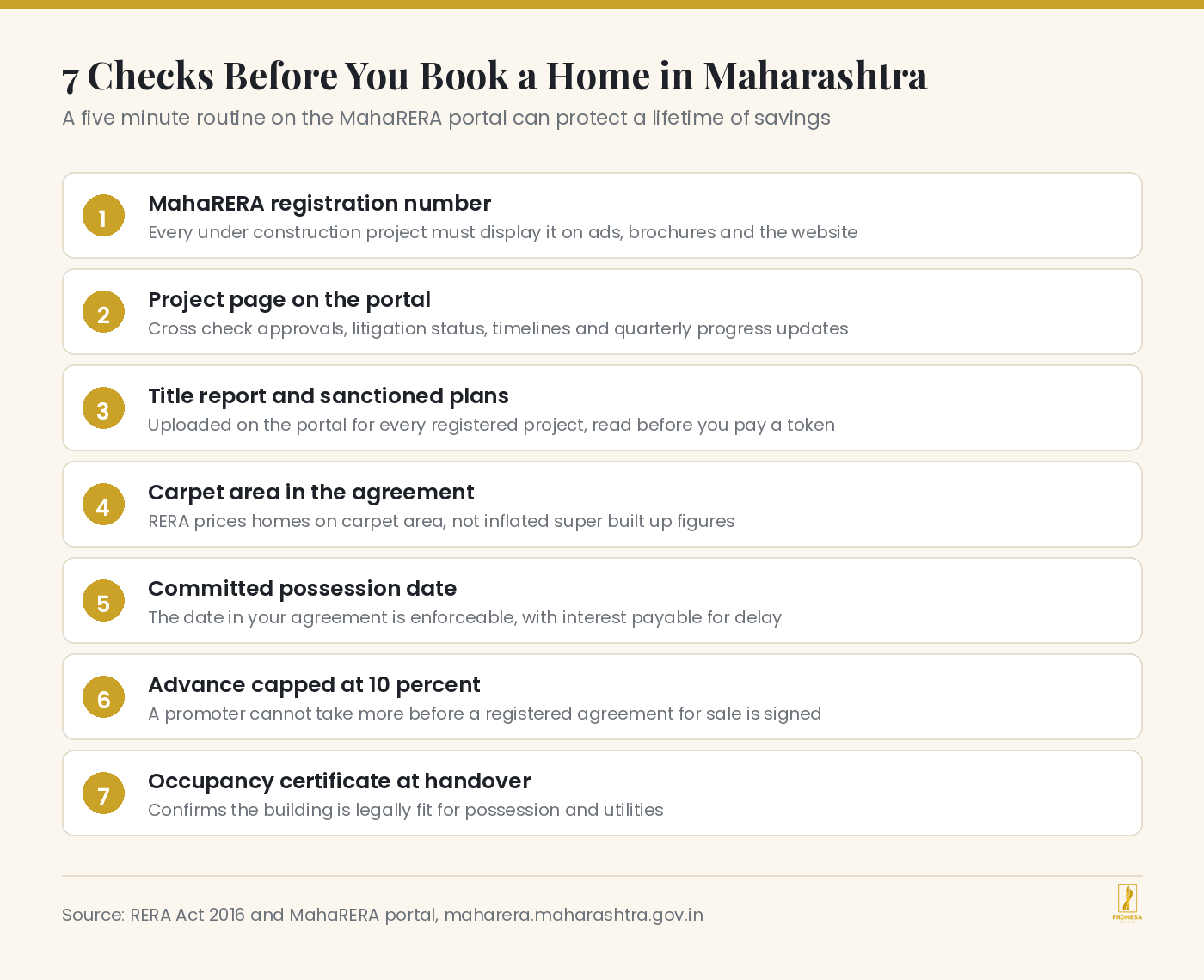
Here is how to run the checks. Open the official portal at maharera.maharashtra.gov.in, choose the project search option and enter the project name or registration number from the advertisement. The project page shows you the promoter’s details, approvals, litigation status, the declared possession date and quarterly progress updates. Read the uploaded title report and sanctioned plans before paying any token. Confirm that your draft agreement states the carpet area and the possession date exactly as registered. If any of these pieces is missing or does not match, that is your signal to pause.
Buy with confidence
Every Promesa project, fully documented and verifiable
Explore ongoing and upcoming residences across South and Central Mumbai, then verify each one yourself on the MahaRERA portal. We would not have it any other way.
How Promesa Realty Builds RERA Into Everything
For top real estate builders in Mumbai, RERA is not a hurdle to clear. It is a codification of how a serious developer should have been operating all along. Promesa Realty’s foundations go back to 1987 through Darsshan Properties and Hirani Ventures, which means our processes were shaped by decades of delivered buildings before the Act made those disciplines mandatory. You can read that full journey on our about us page.
In practice, compliance shows up in the details buyers actually feel. Every new project we launch is registered with MahaRERA, and we encourage buyers to look us up on the portal before they visit a show flat. Agreements are written on carpet area. Collections flow through the mandated account structure, so funds raised for Promesa Fremont in Lalbaug build Promesa Fremont, and funds raised for Promesa Castor in Khetwadi build Promesa Castor. Progress is documented quarter after quarter, the way it was for completed landmarks like Promesa Adi Darsshan in Lower Parel and Promesa WestEnd in Dadar.
The same transparency extends to how we present inventory. Whether you are comparing flats in Lower Parel, evaluating a 2 BHK flat in Dadar, shortlisting 1 BHK homes in Dadar or researching property in Ghatkopar, the configuration, carpet area and timeline you see is the one that stands behind a registered agreement. And because location decides long term value as much as legal safety does, we plan projects around the city’s growth corridors, a strategy we detailed in our analysis of how Mumbai’s infrastructure boom is reshaping real estate value and our outlook on the Mumbai real estate market in 2026.
Frequently Asked Questions
What is MahaRERA?
MahaRERA is the Maharashtra Real Estate Regulatory Authority, established on 1 May 2017 under the Real Estate (Regulation and Development) Act, 2016. It registers real estate projects, enforces disclosure and financial discipline, and resolves complaints between home buyers and promoters. It is widely regarded as the most active real estate regulator in India.
How do I check whether a project is RERA registered?
Visit maharera.maharashtra.gov.in, open the project search section and enter the project name, promoter name or registration number. Every registered project has a public page showing approvals, title documents, timelines, litigation status and quarterly progress updates. If a project being sold to you does not appear there, do not proceed.
What are my options if possession of my flat is delayed?
Under Section 18 of the Act, you may withdraw from the project and claim a full refund of what you paid along with prescribed interest, or you may continue with the project and claim interest for every month of delay until possession. Complaints are filed online with MahaRERA, and orders that are not honoured can be executed as recovery warrants through the district collector.
What is the difference between carpet area and super built up area?
Carpet area is the net usable floor area inside your home, measured wall to wall. Super built up area added proportionate shares of lobbies, staircases, shafts and other common spaces, which inflated the quoted size. RERA requires homes to be sold on carpet area, so the number in your agreement reflects the space you will actually live in.
Does RERA apply to completed buildings with an occupancy certificate?
No. Projects that had already received their occupancy certificate before the Act came into force do not require registration, and a project completes its RERA lifecycle once the occupancy certificate is issued. RERA’s protections are designed around under construction homes, which is where buyer risk is concentrated.
The Bottom Line
RERA turned home buying in Maharashtra from an act of faith into a verifiable transaction. The registration number, the locked accounts, the carpet area, the enforceable possession date and the five year quality obligation together form a safety architecture that did not exist a decade ago. The buyers who benefit most are the ones who use it: check the portal, read the disclosures and choose developers whose record welcomes that scrutiny.
Promesa Realty has been building for Mumbai families since 1987, and we treat the transparency RERA demands as the starting point of trust, not the finish line.
Ready to buy with complete peace of mind?
Speak with our team about RERA registered residences in Lalbaug, Khetwadi, Lower Parel, Dadar and beyond. Ask us anything, including the questions in this guide.
Data sources: MahaRERA official portal; government recovery statistics reported by The Realty Today, January 2026; national complaint and registration data from the Central Advisory Council meeting of September 2025 via iPleaders; MahaRERA bank account directions summarised by Lexology; Knight Frank India and NAREDCO report coverage by Business Standard, August 2025. Figures are as reported on the dates cited and may be updated by the respective authorities. This article is for general information and is not legal advice.